The Digitrax DCC system utilizes a network called 'Loconet' which allows for communication between the 'Command Station' and various track side modules.
These modules can be from any manufacturer provided they have a 'LocoNet' interface.
Module's include:
Occupancy Detectors - These provide an indication of loco, or rolling stock(with resistor wheel sets) in a specific track section.
Point Controller - These provide a means of operating point motors.
Short Circuit Detectors - These provide a means of detecting short circuits in specified area's so as to keep other areas operational.
Input/Output Devices - hese provide a means of setting outputs and reading inputs of connected equipment (Signals, Points, Level Crosings, Lights)
Servo Controllers - Thes provide a means of controlling Servo motors to operate points semafore signals and crossing gates
PC Serial Interface - Provides a means of connecting a PC
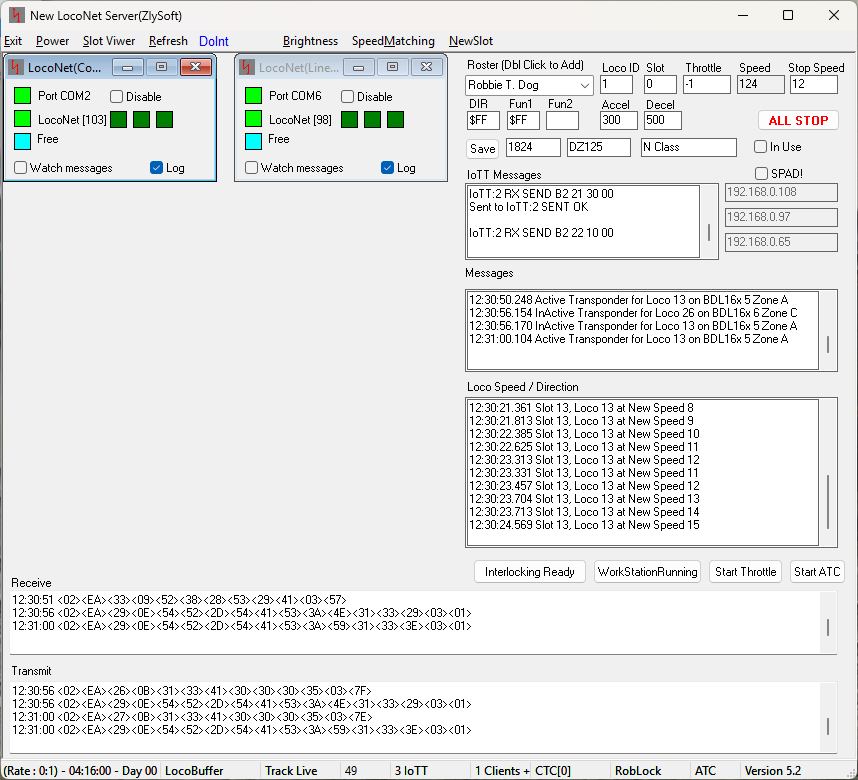

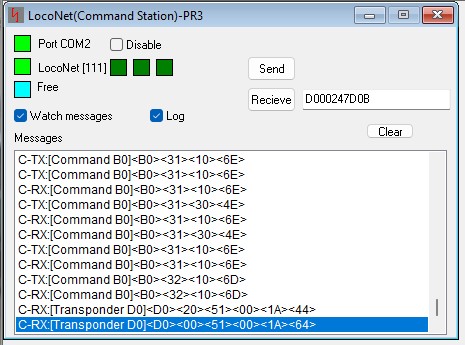
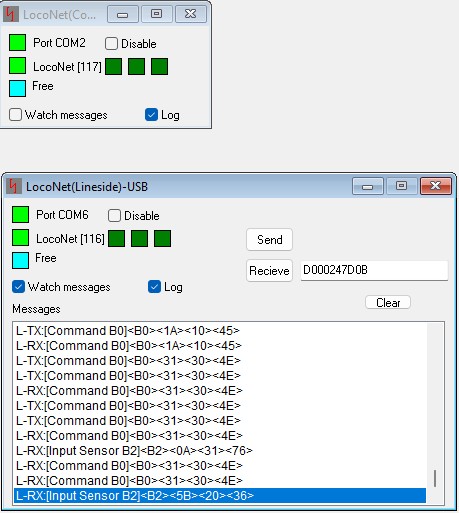
The Command Station link is bi-directional and uses the Digitrax 'LocoNet' protocol.
The Command Station transmits all all Locomotive decoder messages on this as well as lineside inputs it recieves from the Digitrax Occupancy Detectors, Point Controllers and Power Management Units
NetServer sends locomotive related messages from the automatic driving applications as well as lineside commands.


The Lineside link also uses 'LocoNet' but only talks to the lineside I/O and Servo controllers.
The Lineside modules are either 16 Input/Output controllers called 'LocoIO' and can be individually configured with a unique address for either Input or Output,
the other type is called LocoServer, and this has 8 configurable servo outputs and 4 digital lines which can e configured as Input or Output.

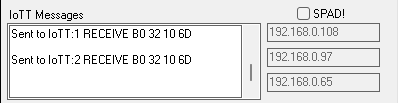
The IoTT (Internet of Toy Trains) link is bi-directional and uses a subset of the Digitrax 'LocoNet' protocol to send commands and received Inputs using TCP/IP over WiFi .
The link was originalled to communicate with a Input/Output modules developed by Hans Tanner for IoTT, subsequently I further enhanced the link to communicate with Raspberry Pi's.
The IoTT module feeds the occupancy state of the tracks in my storage sidings, I also have a Raspberry Pi to control points, signals and Ligting at Ashglen Station, provide track occupancy feed back.


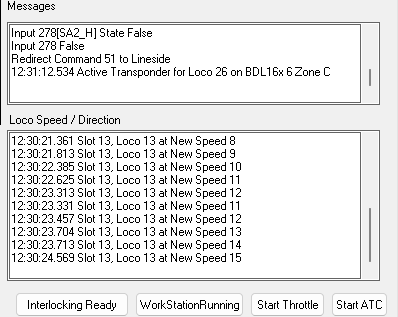
The NETSERVER has 2 information windows:
Messages: This window reports changes to inputs as they occur. These messages are derived from input status messages from all links.
Loco Speed/Direction: This window reports changes to loco speed and direction, with the associated DCC slot number.
Buttons: These are used to manually start the other applications in the system.

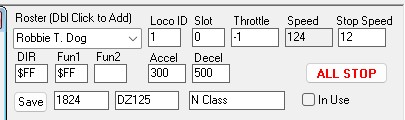
The Roster panel provides the means of setting parameters for each locomotive for use by the Automatic Routing Applications aswell as providing realtime speed, direction and function states.